Distance from Vertex of Triangle to Orthocenter/Proof
Theorem
Let $\triangle ABC$ be a triangle with sides $a$, $b$ and $c$ opposite vertices $A$, $B$ and $C$ respectively.
Let $H$ be the orthocenter of $\triangle ABC$.
Then:
- $AH = 2 R \size {\cos A}$
where $R$ denotes the circumradius of $\triangle ABC$.
Proof
 | This page has been identified as a candidate for refactoring of medium complexity. In particular: separate into subpages, one for acute and one for obtuse. Until this has been finished, please leave {{Refactor}} in the code.
New contributors: Refactoring is a task which is expected to be undertaken by experienced editors only. Because of the underlying complexity of the work needed, it is recommended that you do not embark on a refactoring task until you have become familiar with the structural nature of pages of $\mathsf{Pr} \infty \mathsf{fWiki}$.To discuss this page in more detail, feel free to use the talk page. When this work has been completed, you may remove this instance of {{Refactor}} from the code. |
This proof is for the case when $A \le 90 \degrees$.
The proof of the obtuse case is very similar.
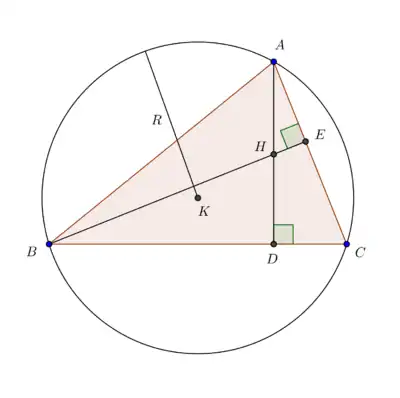
We construct the circumcircle of $\triangle ABC$, whose circumcenter is $K$ and whose circumradius is $R$.
We construct the orthocenter $H$ of $\triangle ABC$ as the intersection of the altitudes $AD$ and $BE$.
First we note the following:
| \(\ds \angle ABH\) | \(=\) | \(\ds \angle ABE\) | ||||||||||||
| \(\ds \) | \(=\) | \(\ds 180 \degrees - \angle AEB - \angle EAB\) | Sum of Angles of Triangle equals Two Right Angles | |||||||||||
| \(\ds \) | \(=\) | \(\ds 180 \degrees - 90 \degrees - \angle EAB\) | by construction | |||||||||||
| \(\text {(1)}: \quad\) | \(\ds \) | \(=\) | \(\ds 90 \degrees - A\) | simplifying |
Consider $\Box EHCD$.
$\angle CDH$ and $\angle CEH$ are both right angles.
Hence from Opposite Angles of Cyclic Quadrilateral sum to Two Right Angles, $\Box EHCD$ is a cyclic quadrilateral.
Thus:
| \(\ds \angle AHB\) | \(=\) | \(\ds \angle EHD\) | Two Straight Lines make Equal Opposite Angles | |||||||||||
| \(\ds \angle EHD + \angle DCE\) | \(=\) | \(\ds 180 \degrees\) | Opposite Angles of Cyclic Quadrilateral sum to Two Right Angles | |||||||||||
| \(\text {(2)}: \quad\) | \(\ds \leadsto \ \ \) | \(\ds \angle AHB\) | \(=\) | \(\ds 180 \degrees - C\) |
Hence:
| \(\ds \dfrac {AH} {\sin \angle ABH}\) | \(=\) | \(\ds \dfrac {AB} {\sin \angle AHB}\) | Law of Sines applied to $\triangle ABH$ | |||||||||||
| \(\ds \leadsto \ \ \) | \(\ds \dfrac {AH} {\map \sin {90 \degrees - A} }\) | \(=\) | \(\ds \dfrac {AB} {\map \sin {180 \degrees - C} }\) | from $(1)$ and $(2)$ | ||||||||||
| \(\ds \leadsto \ \ \) | \(\ds \dfrac {AH} {\cos A}\) | \(=\) | \(\ds \dfrac {AB} {\sin C}\) | Sine of Complement equals Cosine, Sine of Supplementary Angle | ||||||||||
| \(\ds \) | \(=\) | \(\ds 2 R\) | Law of Sines applied to $\triangle ABC$ |
The result follows.
$\blacksquare$
Sources
- 1953: L. Harwood Clarke: A Note Book in Pure Mathematics ... (next): $\text V$. Trigonometry: The orthocentre