Geometrical Interpretation of Complex Addition
Theorem
Let $a, b \in \C$ be complex numbers expressed as vectors $\mathbf a$ and $\mathbf b$ respectively.
Let $OA$ and $OB$ be two adjacent sides of the parallelogram $OACB$ such that $OA$ corresponds to $\mathbf a$ and $OB$ corresponds to $\mathbf b$.
Then the diagonal $OC$ of $OACB$ corresponds to $\mathbf a + \mathbf b$, the sum of $a$ and $b$ expressed as a vector.
Proof
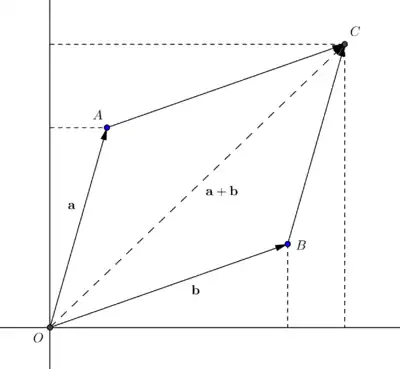
Let $a = a_x + i a_y$ and $b = b_x + i b_y$.
Then by definition of complex addition:
- $a + b = \paren {a_x + b_x} + i \paren {a_y + b_y}$
Thus $\mathbf a + \mathbf b$ is the vector whose components are $a_x + b_x$ and $a_y + b_y$.
Similarly, we have:
- $b + a = \paren {b_x + a_x} + i \paren {b_y + a_y}$
Thus $\mathbf b + \mathbf a$ is the vector whose components are $b_x + a_x$ and $b_y + a_y$.
It follows that both $\mathbf a + \mathbf b$ and $\mathbf b + \mathbf a$ both correspond to the diagonal $OC$ of $OACB$.
$\blacksquare$