Geometrical Interpretation of Complex Subtraction
Theorem
Let $a, b \in \C$ be complex numbers expressed as vectors $\mathbf a$ and $\mathbf b$ respectively.
Let $OA$ and $OB$ be two adjacent sides of the parallelogram $OACB$ such that $OA$ corresponds to $\mathbf a$ and $OB$ corresponds to $\mathbf b$.
Then the diagonal $BA$ of $OACB$ corresponds to $\mathbf a - \mathbf b$, the difference of $a$ and $b$ expressed as a vector.
Proof
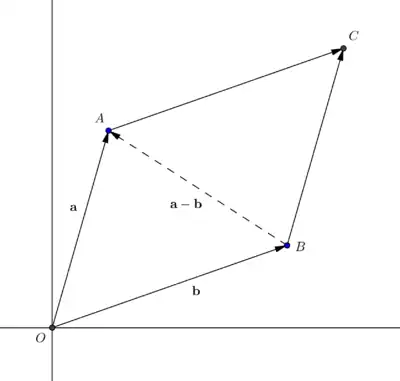
By definition of vector addition:
- $OB + BA = OA$
That is:
- $\mathbf b + \vec {BA} = \mathbf a$
which leads directly to:
- $\vec {BA} = \mathbf a - \mathbf b$
$\blacksquare$
Sources
- 1957: E.G. Phillips: Functions of a Complex Variable (8th ed.) ... (previous) ... (next): Chapter $\text I$: Functions of a Complex Variable: $\S 3$. Geometric Representation of Complex Numbers
- 1960: Walter Ledermann: Complex Numbers ... (previous) ... (next): $\S 2$. Geometrical Representations
- 1981: Murray R. Spiegel: Theory and Problems of Complex Variables (SI ed.) ... (previous) ... (next): $1$: Solved Problems: Graphical Representations of Complex Numbers. Vectors: $8 \ \text {(a)}$