Kepler's Laws of Planetary Motion
Physical Laws
are a set of three physical laws that describe the motion of planets in the solar system.
First Law
- Planets move around the sun in elliptical orbits, with the sun at one focus.
Second Law
- The line joining the sun and a planet sweeps out equal areas in equal times.
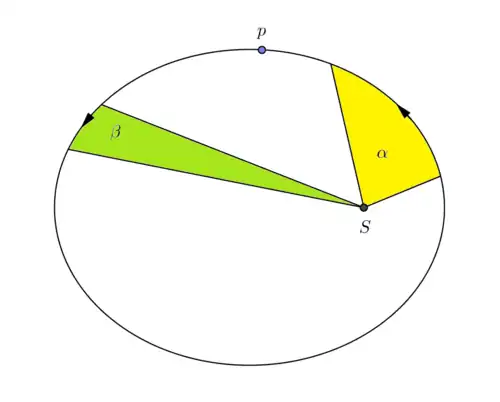
Third Law
- The square of the period of the orbit of a planet around the sun is proportional to the cube of its mean distance from the sun.
Also known as
are also known as just:
Source of Name
This entry was named for Johannes Kepler.
Historical Note
Kepler derived his in the early $1600$s from a concentrated study over the course of $20$ years of the colossal wealth of observational data which had been made previously by Tycho Brahe of the behavior of the planets of the solar system, and in particular Mars.
The first two of these results he published in his gigantic $1609$ work Astronomia Nova.
The third appears some ten years later in his Harmonices Mundi of $1619$.
It was Isaac Newton who managed to interpret these and so work out what is now known as Newton's Law of Universal Gravitation, from which can straightforwardly be derived.
Sources
- 1937: Eric Temple Bell: Men of Mathematics ... (previous) ... (next): Chapter $\text{VI}$: On the Seashore
- 1992: George F. Simmons: Calculus Gems ... (previous) ... (next): Chapter $\text {B}.25$: Kepler's Laws and Newton's Law of Gravitation
- 1998: David Nelson: The Penguin Dictionary of Mathematics (2nd ed.) ... (previous) ... (next): Kepler's laws
- 2008: David Nelson: The Penguin Dictionary of Mathematics (4th ed.) ... (previous) ... (next): Kepler's laws
- 2008: Ian Stewart: Taming the Infinite ... (previous) ... (next): Chapter $8$: The System of the World: Kepler
- 2014: Christopher Clapham and James Nicholson: The Concise Oxford Dictionary of Mathematics (5th ed.) ... (previous) ... (next): Kepler's laws of planetary motion