Nine Point Circle Theorem
Theorem
Let $\triangle ABC$ be a triangle.
These $9$ points:
- the feet of the altitudes of $\triangle ABC$
- the midpoints of the sides of $\triangle ABC$
- the midpoints of the lines from the vertices of $\triangle ABC$ to the orthocenter $H$ of $\triangle ABC$
all lie on the circumference of a circle.
The center $M$ lies on the Euler line of $\triangle ABC$, at the midpoint between the orthocenter $H$ and the circumcenter $O$.
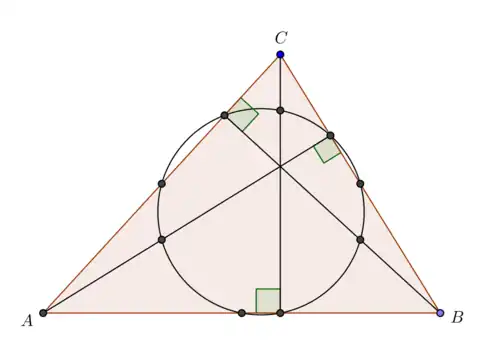
This circle is known as the Feuerbach circle, or the nine point circle.
Proof
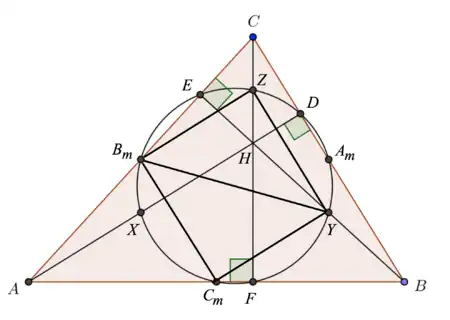
Let the altitudes of $\triangle ABC$ be $AD$, $BE$ and $CF$.
Let $H$ be the orthocenter of $\triangle ABC$.
Let $X$, $Y$ and $Z$ bisect $AH$, $BH$ and $CH$, respectively.
Let $A_m$, $B_m$, and $C_m$ bisect $BC$, $AC$, and $AB$, respectively.
| \(\ds \triangle AHC\) | \(\sim\) | \(\ds \triangle B_mZC\) | Triangles with One Equal Angle and Two Sides Proportional are Similar | |||||||||||
| \(\ds \leadsto \ \ \) | \(\ds AXHD\) | \(\parallel\) | \(\ds B_mZ\) | |||||||||||
| \(\ds \triangle AHB\) | \(\sim\) | \(\ds \triangle C_mYB\) | Triangles with One Equal Angle and Two Sides Proportional are Similar | |||||||||||
| \(\ds \leadsto \ \ \) | \(\ds AXHD\) | \(\parallel\) | \(\ds C_mY\) | |||||||||||
| \(\ds B_mZ\) | \(\parallel\) | \(\ds C_mY\) | Parallelism is Transitive Relation |
| \(\ds \triangle YZH\) | \(\sim\) | \(\ds \triangle BCH\) | Triangles with One Equal Angle and Two Sides Proportional are Similar | |||||||||||
| \(\ds \leadsto \ \ \) | \(\ds YZ\) | \(\parallel\) | \(\ds BDC\) | |||||||||||
| \(\ds \triangle AC_mB_m\) | \(\sim\) | \(\ds \triangle ABC\) | Triangles with One Equal Angle and Two Sides Proportional are Similar | |||||||||||
| \(\ds \leadsto \ \ \) | \(\ds C_mB_m\) | \(\parallel\) | \(\ds BDC\) | |||||||||||
| \(\ds C_mB_m\) | \(\parallel\) | \(\ds YZ\) | Parallelism is Transitive Relation |
By Quadrilateral is Parallelogram iff Both Pairs of Opposite Sides are Equal or Parallel:
- $\Box B_mZYC_m$ is a parallelogram.
| \(\ds AXHD\) | \(\perp\) | \(\ds BC\) | Definition of Altitude of Triangle | |||||||||||
| \(\ds ZY\) | \(\parallel\) | \(\ds BC\) | above | |||||||||||
| \(\ds \leadsto \ \ \) | \(\ds ZY\) | \(\perp\) | \(\ds AXHD\) | |||||||||||
| \(\ds B_mZ\) | \(\parallel\) | \(\ds AXHD\) | above | |||||||||||
| \(\ds \leadsto \ \ \) | \(\ds B_mZ\) | \(\perp\) | \(\ds ZY\) | |||||||||||
| \(\ds \angle B_mZY\) | \(=\) | \(\ds 90 \degrees\) | Definition of Perpendicular |
By Parallelogram with One Right Angle is Rectangle:
- $\Box B_mZYC_m$ is a rectangle.
| \(\ds B_mY\) | \(=\) | \(\ds C_mZ\) | Diagonals of Rectangle are Equal |
Draw the circle with $B_mY$ as diameter.
- $Z$ and $C_m$ are also on the circle.
Since $ZC_m = Y B_m$:
- $ZC_m$ is a diameter of the circle.
mutatis mutandis:
- $XA_m$ is a diameter of the circle.
Using diameter $B_mY$, by Thales' Theorem/Converse:
- $E$ is on the circle.
Using diameter $C_mZ$, by Thales' Theorem/Converse:
- $F$ is on the circle.
Using diameter $A_mX$, by Thales' Theorem/Converse:
- $D$ is on the circle.
The result follows.
$\blacksquare$
Also known as
The is also known as:
There is little consistency in the literature.
Also see
Historical Note
The was proved in $1820$ by Jean-Victor Poncelet and Charles Julien Brianchon.
In $1822$, Karl Wilhelm Feuerbach proved that the nine point circle was tangent to the incircle and all $3$ excircles.
Hence this circle is often referred to as the Feuerbach circle.
Sources
- 1986: David Wells: Curious and Interesting Numbers ... (previous) ... (next): $9$
- 1997: David Wells: Curious and Interesting Numbers (2nd ed.) ... (previous) ... (next): $9$
- 1998: David Nelson: The Penguin Dictionary of Mathematics (2nd ed.) ... (previous) ... (next): nine-point circle
- 2008: David Nelson: The Penguin Dictionary of Mathematics (4th ed.) ... (previous) ... (next): nine-point circle (C.J. Brianchon and J.V. Poncelet, 1820; K.W. Feuerbach 1822)
- 2014: Christopher Clapham and James Nicholson: The Concise Oxford Dictionary of Mathematics (5th ed.) ... (previous) ... (next): nine-point circle