Triangle Right-Angle-Hypotenuse-Side Congruence
Theorem
If two right triangles have:
- their hypotenuses equal
- another of their respective sides equal
they will also have:
- their third sides equal
- the remaining two angles equal to their respective remaining angles.
Proof 1
Let $\triangle ABC$ and $\triangle DEF$ be two triangles having sides $AB = DE$ and $AC = DF$, and with $\angle ABC = \angle DEF = 90^\circ$.
- $BC = \sqrt {AB^2 + AC^2}$
and:
- $EF = \sqrt {DE^2 + DF^2}$
- $\therefore BC = \sqrt {AB^2 + AC^2} = \sqrt {DE^2 + DF^2} = EF$
The part that the remaining two angles are equal to their respective remaining angles follows from Triangle Side-Side-Side Congruence.
$\blacksquare$
Proof 2
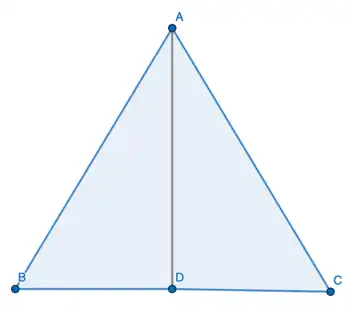
Let $\triangle ADB$ and $\triangle ADC$ both be right triangles.
Let them have equal hypotenuse and one leg ($AD$) equal.
by hypothesis:
- $AB = AC$
- $\angle ADB = \angle ADC = \ $ one right angle
- $AD$ is shared
So the two triangles can be drawn as shown with $BD$ and $DC$ joined at $D$.
By addition:
- $\angle BDA + \angle CDA = \angle BDC = \ $ two right angles
By Two Angles making Two Right Angles make Straight Line:
- $BDC$ is one straight line
- the points $BDC$ are collinear
So:
- $\triangle ABC$ is a triangle.
By definition of isosceles triangle:
- $\triangle ABC$ is isosceles.
Since $AD \perp BDC$, by definition of perpendicular bisector:
- $BD = DC$
By Triangle Side-Angle-Side Congruence:
- $\triangle ABD \cong \triangle ACD$
$\blacksquare$
Also known as
is also known as RHS or the RHS Condition.
However, because RHS is also used as a standard abbreviation for the right hand side of an equation, it is deprecated on $\mathsf{Pr} \infty \mathsf{fWiki}$ on account of ambiguity.
Sources
- 1968: M.N. Aref and William Wernick: Problems & Solutions in Euclidean Geometry ... (previous) ... (next): Chapter $1$: Triangles and Polygons: Theorems and Corollaries $1.15$
- 1998: David Nelson: The Penguin Dictionary of Mathematics (2nd ed.) ... (previous) ... (next): congruent: 1. $(4)$
- 2008: David Nelson: The Penguin Dictionary of Mathematics (4th ed.) ... (previous) ... (next): congruent: 1. $(4)$