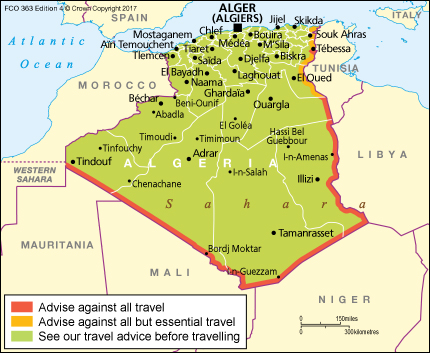
I'd like to visit Tamanrasset and the Hoggar Mountains (see also this question), so I was happy to see that the FCO no longer advises against travel there:

Source: FCO.
The Foreign and Commonwealth Office (FCO) advise against all travel to areas within:
- 30km of the borders with Libya, Mauritania, Mali and Niger
- 30km of the border with Tunisia in the provinces of Illizi and Ouargla and in the Chaambi mountains area
That doesn't sound too bad. But the US state department considers the situation more seriously:
Avoid travel to rural areas within 50 km (31 miles) of the border with Tunisia and within 250 km (155 miles) of the borders with Libya, Niger, Mali, and Mauritania due to terrorist and criminal activities, including kidnapping.
(...)
Avoid Do not travel overland in the Sahara Desert due to terrorist and criminal activity, including kidnapping.
The Dutch government advices against all travel to Algeria, in particular against the areas corresponding to the ones indicated by the US State Department:

The French government used to be even more serious, is now a little less serious than the Dutch:
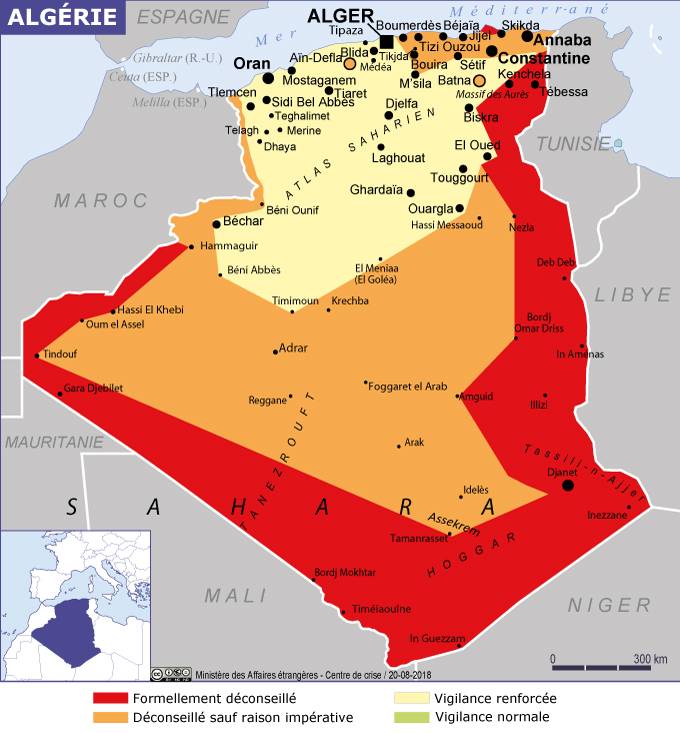
On both Dutch and French charts red means "No travel" and orange means "Only necessary travel".
So I might have to wait a bit with this trip after all. But why do those travel advisories diverge so much? In large areas of the country, the FCO does not advise against travel at all, the US and Dutch government advice against all but essential travel, and the French government advice against all travel. That's the difference between the safest and least-safe category: a very large difference. Is it safer for UK than for US or French citizens? Is the UK government more optimistic? More up-to-date? Or are there other reasons to explain the discrepancy?