12

I want to travel from south Germany (say Munich) to Scotland (say Edinburgh), but with no flight as I want to protect the climate. Meanwhile it is again possible to book the Eurostar train connection to London via Deutsche Bahn. But then I have to book another train to Edinburgh.

Is there a ship connection? How can I get there best in regards to price and travel time?

Nick
  • 237
  • 2
  • 5

9 Answers9

29

Maybe not the cheapest but possibly the quickest, easiest, and most comfortable is by train. Munich to Paris. Paris to London via Eurostar through the tunnel. London to Edinburgh.

You can substitute Brussels or Amsterdam for Paris (thanks to Nicolas Formichella).

Substituting coaches for some or all of the trains might reduce the cost but it will be slower and less comfortable.

You could rent or buy a car and drive but this is liable to be the most expensive and maybe even the slowest.

Addition

Smarste reminds me that the motivation of avoiding flying is to reduce emissions. In which case, the train is probably your best choice. A big advantage of trains is that they are (mostly) powered by electricity which can be produced by means other than burning stuff. The car is probably the worst unless you have an unusually efficient car with many passengers.

Michael Seifert added a useful link in a comment: https://ourworldindata.org/travel-carbon-footprint

badjohn
  • 7,785
  • 1
  • 27
  • 66
18

As usual The man in seat 61 has lots of advice on the subject.

See the section London to Stuttgart & Munich which gives 4 options to London:

  • TGV to Paris, Eurostar to London
  • ICE to Cologne, Thalys or ICE to Brussels, Eurostar to London
  • Nightjet sleeper train to Brussels, Eurostar to London
  • Trains to Hoek van Holland, ferry to Harwich, train to London
  • Trains to Amsterdam, ferry to Newcastle, train
  • Trains to Rotterdam, ferry to Hull, train

These mostly point to London, so another train to Edinburgh is needed. Itineraries from the various harbours used by ferries to Edinburg may or may not make sense.

The page has lots of details about each of these options, including timetables, prices, pictures and tips.

There are also sections for:

jcaron
  • 99,044
  • 6
  • 191
  • 378
16

The comfortable route, if you can sleep on a train:

  • NightJet 468 from Munich East to Paris.
  • EuroStar from Paris to London
  • Caledonian Sleeper from London to Glasgow/Edinburgh/Inverness/Aberdeen/Fort William

This gives you some time in Paris and/or London as well, depending on which EuroStar you take.

Simon Richter
  • 1,761
  • 1
  • 12
  • 14
9

The part of the world you want to travel through has some of the best public transport systems in the world. There are countless options for travelling with trains (faster, more comfortable, more expensive) or buses (slower, less comfortable, cheaper). Not possible to list them all, but you should definitely have a look at the Seat61 website (see jcaron's answer). However, it's not likely you'll be able to buy a single ticket for your entire journey.

The fastest and most straightforward (but probably not the cheapest) option would be a Eurostar train to London and another train to Scotland from there. If you're not on a tight schedule and are willing to experiment a bit, you can search timetables for cheaper connections, either trains or buses. You can also cross the English Channel as a foot passenger on a ferry. There are countless ferry connections, from France or from the Netherlands, and you can save a lot of money by doing some research.

Maybe it's worth mentioning that you can buy a rail pass (e.g. InterRail) for the UK (or for any other country but a UK pass would be most useful), if you want to travel around. Just keep in mind that some long-distance train services in the UK (as well as in other countries) require a reservation that must be bought separately if you have a rail pass.

And the last piece of advice: don't forget your passport! EU nationals in general cannot enter the UK with their ID cards.

phoog
  • 143,317
  • 20
  • 298
  • 485
Johnnyjanko
  • 7,284
  • 1
  • 26
  • 47
4

The train connection mentioned by badjohn is probably the most straight-forward non-flying way to get from Munich to Edinburgh. Leaving Munich at 8:45 in the morning, you can (provided everything goes according to plan) reach Edinburgh at 21:24 on the same day. Unfortunately, to my knowledge there is no operator that sells a single ticket for the entire connection, which will increase both price and the risk of delays.

The most sensible way to incorporate a ferry could be to to take the train to Amsterdam instead (still takes about 9h), then the overnight ferry to Newcastle. From Newcastle to Edinburgh its just another 1:30 on the train. You can get a single train ticket from Munich to Amsterdam, but the ferry doesn't seem to be cheap. If you are travelling with multiple people, this option probably becomes more attractive as you can share a cabin. Otherwise, the main advantage of this option probably is that you are not spending over 10h on a train in a single day.

Arno
  • 3,203
  • 13
  • 23
4

I have done something similar a few years back (in 2019), for health reasons.

I used an Interrail Global Pass (https://www.interrail.eu/en), which is 258€ (less for age <27 or >60) for both trips (+80€ seat reservations, I'll talk about that later). Not necessarily cheap, but convenient. And you have two days left that you can use in Scotland - like going to Glasgow, Dundee or Inverness.

Our Itinerary was via Frankfurt and Brussels - which (at least back then) was quicker and more convenient than Paris.

All usual German trains are included in the Interrail pass, night trains (and the Eurostar and many British trains) do require seat reservations. As these reservations can be sold out quickly, we booked them once they became available (120 days or 90 days before departure). Deutsche Bahn agents helped me to buy these reservations, but I find it just as easy to buy directly on the interrail website.

For the British seat reservations, I had to call the British train company (and it being Britian, there are different ones...). I used LNER, they have direct service from London's Kings Cross to Scotland, and back then they didn't even want payment for the seat reservation - I just got a code I could enter at a ticket machine in Kings Cross and it printed my seat reservation. I didn't get to sit on that seat - to me it looked like it was not common in these trains to have a reservation at all - but I got a different seat just fine.

alex berne
  • 141
  • 2
4

I hate flying, all the security, delays, etc. Would rather work on the train. Eat in the dining car, the food may be lousy, cost high, but you can't beat the view.

I've taken parts of this trip (Basel - London) and if it were me, I would choose the following routing:

  • Munich to Frankfurt, probably hourly ICE trains
  • Frankfurt to Brussels, I used the "ICE International" IIRC 4 a day
  • Overnight in Brussels, I usually stayed in the Ibis right across from the Brussels Midi station
  • First Eurostar to London
  • Walk across the street from St Pancras (not Pancreas) to Kings Cross and grab one of the services to Edinburgh

I realise I could travel via Paris, but it's an unpleasant station change (Gare de Lyon to Gare du Nord) with suitcases on the Metro.

And by all means, use a Eurail or Interrail pass. Especially in the UK, where the ordinary fares are very high.

Another reason to break your journey in Brussels is that in the recent past there have been some service disruptions with the ICE International where one is cancelled, or departs from Brussels Nord, or worse yet, you need to board a Belgian train to connect with the rerouted ICE waiting in some small station in some small town (forget where, somewhere near Liege) along with hundreds of other irate travelers.

I always felt that the Eurostar should be the first train of the day, as it's a hard deadline and there is no last-minute service as there is with Renfe in Barcelona, Madrid, etc. Eurostar check-in these days is every bit as nasty as in an airport, particularly post Brexit.

For what it's worth, the ICE International trains need to operate on both the German 25kv electrification and the legacy 3kv DC in Belgium, very probably there aren't that many spare trains, so if one breaks down, something gets cancelled.

Frankly, I've had too many cancellations and have given up, but will try again maybe later in the Fall.

The Brussels Ibis used to be fairly inexpensive (EUR 70) but times have changed and it's probably more.

Alternatively, there is Amsterdam, and there is an Ibis right at the station, but it's a longer journey (no cost difference using Interrail) and it's unclear whether the Ibis would be inexpensive.

Last and certainly least, I normally don't reserve seats in Germany, mostly to be able to change plans on the fly when something is late. This has never been a problem for me, but I travel light.

My preference is to avoid night trains. When I was a young man, I would travel to Vienna on a night train, but sleep in a compartment with the seats folded. First class helped here.

Bill Early
  • 51
  • 2
3

As others mentioned, the connection is there and pretty convenient.

Regarding the financial aspect, do consider an Interrail (if you are a EU resident) or Eurail (if from outside EU) pass. You pay a flat fee for a fixed number of travel days. Can be bought at any train station, or online as an electronic pass with the mobile app delivered in 30 minutes. Note that the Interrail pass cannot be used in your country of residence if you are from the EU, with the exception of two days for getting out and coming back.

You break even pretty quickly when compared to same-day flexible fares in Germany and UK. For example, you can get four days of travel for less than the price of same-day one-way point-to-point tickets bought at the normal price.

Do not hesitate to splurge on the 1st class, the pass prices are just 25% more. It is less crowded; more chances to get a seat, more leg & elbow room, no rowdy kids, food orders brought to your seat in Germany...

The extra costs you may consider with the pass are the reservations:

  • Within Germany and Netherlands, you can hop on any train you want. Reservations are possible but optional within Germany.

  • The ICE between Frankfurt and Amsterdam may have been made reservation-mandatory this summer for the holiday peak; an exception. Reservations can be done at DB (train stations & the DB Navigator app) for a nominal price. The Intercity between Hannover and Amsterdam is an an alternative; you can board without reservations although it can be crowded.

  • Eurostar can be a challenge. Passholder tickets cost a nominal fee, can already be sold out even if there are seats left on the train.

  • Sleeper trains are a great time-saver. You can swallow nearly 1000km while sleeping. They are so successful that some route can be sold out weeks in advance. Reservation fees depend on the accommodation you choose. On Nightjets:

    • Couchette 39€-59€, padded bunk in room of 6- or 4-person mixed-sex or women-only compartments

    • Sleeping car can be 80€ and above but a decent experience with actual beds, max. 3 in the same room, breakfast included, shower in the car or next to your room, there can be special discounts. And if lucky you can end up having the room to yourself

    • Personal advice: get a couchette at least. If you dare taking the seated carriage to save money, your mileage may vary. Can be compartments in which the lights can be turned off, or a regular seated car with bright lights all night long and no way to secure you belongings.

The ferry can be partially covered, depending on the line. Some lines offer discounts to passholders on the passage (not cabins), listed on the Interrail website.

Another creative approach to get through Germany is possible: D-Ticket. For 49€ per calendar month, you get unlimited travel on all the country using the "slow" trains (regional lines, no IC / ICE) and most local transportation (bus, tram, subway / u-bahn...). You can subscribe from the DB Navigator app. The twist: you cannot pay by card; only by bank transfer using an IBAN, and have to think about revoking it after you are done not to be automatically charged the next month. A Revolut account works, personally tested.

DavGin
  • 11,409
  • 8
  • 55
  • 86
2

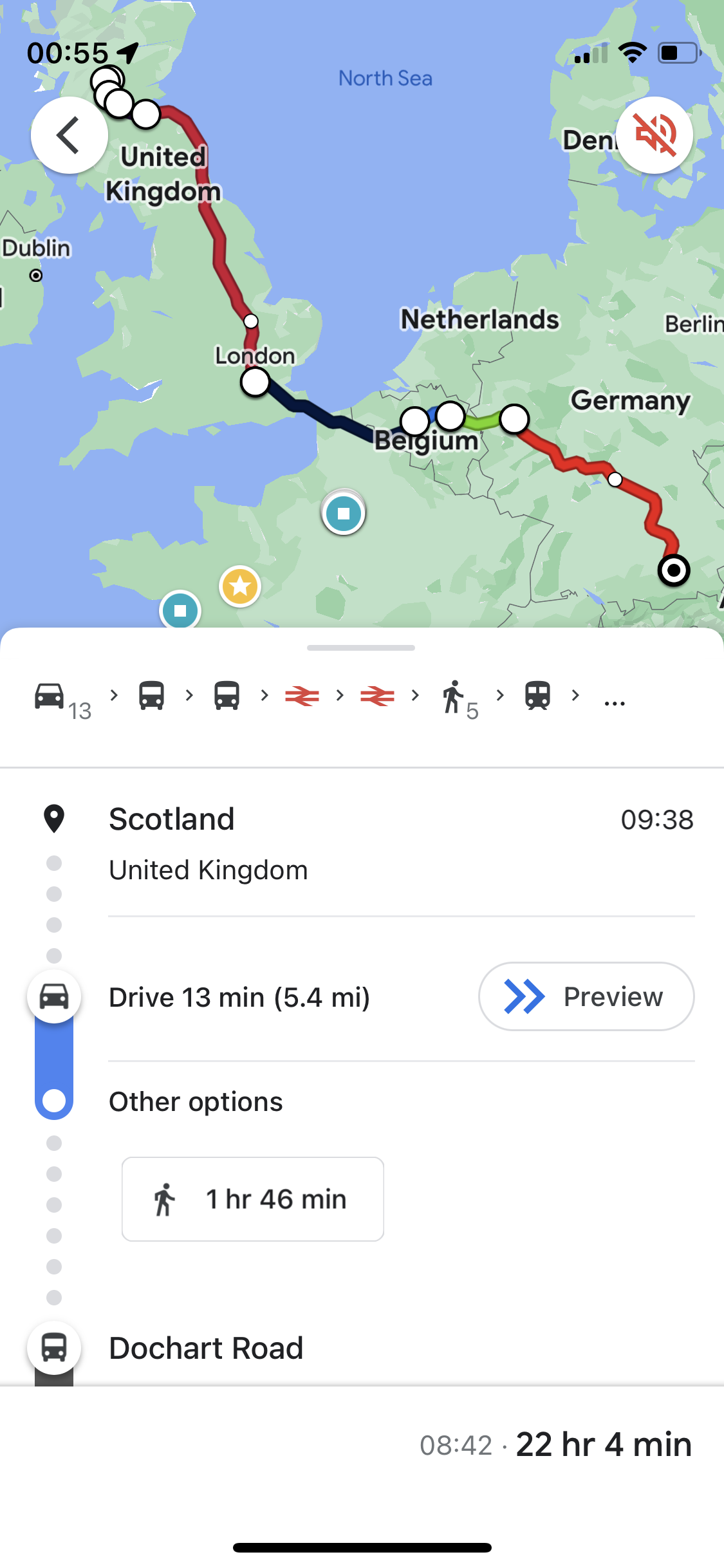
One can simply use Google Maps to get an itinerary that doesn’t use the plane:

enter image description here

I don’t understand the other requirements, as they seem to contradict with one another. Minimizing time is typically at odds with minimizing the cost. And using a ship typically won’t help minimize the time spent.

Franck Dernoncourt
  • 60,186
  • 35
  • 215
  • 416