17

On Google Flights, I searched the FRA-JFK route:

screenshot with three flights

It surprises me that a flight with a layover emits so much less CO2 than a direct flight, as many times I've heard the suggestion that the takeoff is the most polluting phase of the flight and so flights with layovers are more polluting than direct flights.

Might there be something wrong with Google's assessment or is that "rule of thumb" bad advice?

Willeke
  • 63,333
  • 21
  • 165
  • 324
LoremIpsum
  • 468
  • 4
  • 12

5 Answers5

19

As the comments said: the CO₂ estimates depends a lot on the aircraft and other factors. The actual calculation is rather complicated and so Google (and others) have to make a lot of simplifying assumptions.

For the aircraft, it's the fuel efficiency but also the seating arrangement. For example, a Boeing 777 can have 3-3-3 or 3-4-3 seating in economy. Obviously 3-4-3 is more efficient since you cram more passengers into the same space, but it's also a miserable flying experience, so pick your poison.

This being said the numbers that Google provides here seem unrealistic to me. Fuel is the second largest expense for airlines so they are highly incentivized to optimize fuel efficiency. I doubt that KLM can operate a transatlantic flight 40% more efficient than Delta. If that were the case, Delta would be out of business by now.

and so flights with layovers are more polluting than direct flights.

Surprisingly that's not always the case. Above a certain distance it's more efficient to add a fuel stop. For a Boeing 777 that's about 4500km.

Hilmar
  • 119,360
  • 8
  • 205
  • 414
12

In this specific case, the savings are most likely due to the type of aircraft involved. More recent aircraft such as a 787, 350, or 330neo can be a lot more fuel efficient than older aircraft. This comes mostly from more efficient engines, but also from improvements in aerodynamics (the winglets and other tip-of-wing optimisations have surprisingly important effects), or weight optimisations (787s and 350s use a lot of composite materials and are lighter).

There could also be differences in cabin configuration. A denser configuration (smaller row pitch or more seats per row) will result in better efficiency per seat (that's possibly one of the reason the Condor flight on that route shows such a higher efficiency).

If one wants to go into details for a very specific flight (i.e. on a specific date), the exact route flown, and the influence of jet streams can radically change things as well. You could also consider saturation at the airports involved (both in the air and on the ground).

In the more general case, the computation is complex, and it's hard to say that, even with the exact same plans, a direct flight is always necessarily more fuel efficient than one with a stop: while the take-off phase is indeed quite fuel-hungry, and having one rather than two should be better, a direct flight requires more fuel to be carried on board, which weighs a lot, and which will have an impact on the overall fuel consumption.

For instance, an A350-900ULR has a maximum take-off weight of about 280 tons. Out of that, there could be up to 135 t (nearly half!) for fuel, for a flight at max range/payload. The quantity of fuel depends on the distance (but it's not linear as indeed there's a larger need during take-off), so the aircraft would be lighter during most of the flights, and would use less fuel. I know the question has been raised again recently with the recent and upcoming Europe-Australia direct flights, and I believe the answer was that it would actually be more efficient to stop (but we're really at the extremes of aircraft capabilities here).

This answer over at Aviation.SE tells us that the take-off and climb phase uses about as much fuel as one hour of cruise, but doesn't get into details based on how much fuel is on board/the total weight of the aircraft. You could probably get more detailed figures over there.

jcaron
  • 99,044
  • 6
  • 191
  • 378
8

Clicking on the "CO2e" figure on Google flights reveals it to be based on passenger seat miles.

Aircraft flying long haul flights have to carry sufficient fuel for diversions and emergencies in addition to the total amount of fuel needed to fly the plane and passengers to their destination.

On shorter haul flights the amount of fuel taken on board for the plane to reach its destination is less (it's a shorter flight) and weighs less. Allowing for requisite tradeoffs, airlines can reduce the amount of fuel taken on board and/or increase the number of seats allocated for the flight, both of which can reduce carbon emisions per passenger mile.

The savings come from not having to burn fuel to take off and carry a long way before it needs to be fed into the aircraft's engines. Or to put it another way, the fuel burned on the second half of a long distance flight would not need to loaded onto the aircraft if the flight only covered half the distance (roughly speaking of course).

If you break a long haul flight into two shorter flights and refuel at a stop over, you keep the fuel savings of the shorter legs, but add the cost of an additional landing, takeoff and hull pressurization cycle. From the figures this will affect CO2e estimations for the total flight, but they will also be influenced by aircraft design and efficiency.

traktor
  • 251
  • 1
  • 6
6

KLM was sued by an environmental company over alleged "greenwashing." I think your gut instinct is correct in that this is not truly possible. Their score may be lower due to the purchase of carbon offsets. IMHO carbon offsets are a bit of a farce. And it appears that KLM is still making inflated claims about their CO2 emissions and I expect a carbon emissions lawsuit will be next.

https://www.theguardian.com/world/2024/mar/20/dutch-airline-klm-misled-customers-green-claims-court-rules

4

Three reasons, in order of ascending importance.

TL;DR version: With long-haul flights, some extra CO2 comes from lifting more fuel, some more CO2 from flying a bigger airplane, and a lot more CO2 from commercial cargo payload, which large airliners carry and small ones don't.

  1. While it's true that takeoff and climb take the most energy in very short flights, aircraft are equipped with an energy storage device, similar to a hybrid car. That device is the entire aiplane: they accumulate kinetic energy as velocity and potential energy as altitude.

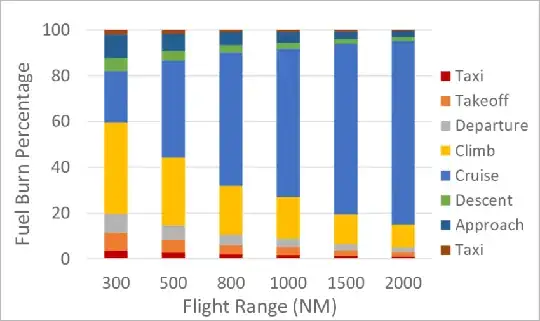
An airliner at 35,000 ft and Mach 0.8 (10 km and 230 m/s) carries an energy equivalent of traveling ~100 miles at cruise conditions, largely what it consumed during takeoff and climb. The only energy irreversibly wasted by the takeoff-landing cycle, aside from engine efficiency losses, is that burnt during taxi and that absorbed by brakes during the landing.
enter image description here

This means that takeoff/landing losses are fairly small. Only takeoff and taxi fuel is spent in addition to cruise fuel for an additional stop.

Meanwhile, fuel costs fuel to carry. The fuel cost of carrying that fuel is approximately 2/3 of the plane's fuel weight % at takeoff. To illustrate, if you take off with 45 tons of fuel at total weight of 100, then 30% of these 45 tons, or 13.5 tons, is spent on lifting and carrying fuel. If you take off with 15 tons, that's only 10% out of 15 tons, or 1.5 tons. For long flights, this is more significant than taxi and takeoff burn.

  1. Large airplanes capable of traveling long distances weigh more per passenger than small airplanes used for short-haul flight. To compare apples to apples and exlude the 737 due to its outdated design, let's take A319 and A350. The A319 carries 125-156 pax in a 40-ton plane, or 260-310 kg per passenger. The A350 at 440 pax limit is a minimum of 320 kg per pax, and realistically 350-450 kg when not at densest possible sardine-class configuration.

It's not all extra fuel tanks. Large airplanes are also more capable in other ways. They have higher tailwind and crosswind limits, they have to be more reliable to get that ETOPS certification, they have better radars and equipment. They offer more room per passenger, both in larger seats, larger overhead bins, more aisle space, more galley and restroom space, and a lot more everything for business and first class seats... yes, we're getting there.

And most importantly, they are much more capable of carrying cargo. Virtually all air freight is containerized. The 737 can't carry containers at all, so it can't really carry cargo, except maybe the occasional urgent parcel. The A320 and the 767 carry special small containers, made for either the A320 only (LD3-45) or the 767 only (LD2). A320 containers are relatively rare, but the 767 is a mainstay of the air freight industry. Anything larger, such as the A300, A330, A340, A350, A380, B747, B787, B777, is specifically designed to fit industry-standard LD3 containers, introduced for the 747, easily swapped between aircraft types.

Air cargo is very important today. Marine shipping is extremely fuel-efficient, but at over a month per trip, it's simply too slow for direct consumer purchases. Almost everything people buy on Amazon or other online marketplaces has to be carried by air, to provide a short enough time between ordering and delivery to trigger the right satisfaction mechanisms that make online shopping attractive. And unlike marine shipping, it's not just from China to the rest of the world; large companies keep their stock in distribution centers in the US and Europe, but there's too many countries to have a warehouse in each one.

  1. They say there are three kinds of lies. The CO2 figures you see per passenger are of the third kind.
    Virtually all large airplanes carry cargo in addition to passengers, and virtually all ultra-long-haul flights carry first-class passengers, which take a lot more of the airplane's space than economy pax. Meanwhile, the CO2 calculations are done by simply dividing expected fuel load by passenger capacity.

And up to half of that CO2 can be produced carrying freight. That's why long-haul aircraft will almost always show higher fuel burn per passenger. They simply carry more things. Besides spending more fuel to carry fuel, they are almost always loaded with cargo.

Therac
  • 994
  • 6
  • 12