7

Consider, say, DL105, DL269, and AA963: Three similar flights. Of course these days we all check which has the best record for cancellations/on time using the data sites.

But it occurred to me it would be great to know which flight is usually less crowded.

Is such data available to consumers?

Fattie
  • 6,023
  • 2
  • 39
  • 84

3 Answers3

10

Not likely, not for free

A good term to search would be load factor, which is a proxy for how full the plane is. The U.S. Bureau of Transportation Statistics defines load factor as

a measure of the use of aircraft capacity that compares Revenue Passenger-Miles (RPMs) as a proportion of Available Seat-Miles (ASMs).

This information is readily available in aggregate, by month. However, you're not likely to be able to get this information on a per-flight, per-airline basis unless (a) you pay for the data or (b) you're working for a company to which the airline has provided this data for the purposes of crunching the numbers to generate a booking curve to help them price their seats. (I was in the latter position.) This data is used for competitive advantage, so it's not going to be readily available.

See also this related (or duplicate) question.

shoover
  • 953
  • 8
  • 13
8

One finding:

I was comparing two real-world Delta flights (a few hours apart). I phoned them and asked and she said "Sure, of course I'll tell you, there are 81 seats left on one and 39 on the other." So that was great! I was surprised and thought they might be cagey about that.

Of course that's just for upcoming.

Fattie
  • 6,023
  • 2
  • 39
  • 84
7

If you are looking at a specific date and route, the easiest might be just to look at the seat map. If you want to fly from BOS to SFO on May 9 on United, the 5 pm flights is pretty full
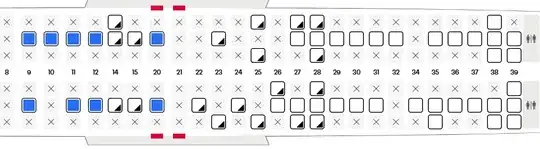
enter image description here

But there is a lot more space on the 6am flight
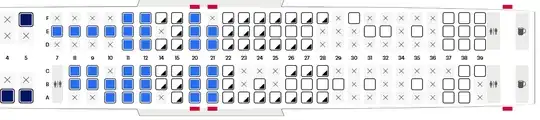
enter image description here

I used to to do this a lot when I was still playing the upgrade waitlist game: try to find the transatlantic routing that has the most open seats in business on the long haul.

Another trivial indicator is price: cheaper tends to be less crowded.

Looking at the "average" load is probably not helpful, since the standard variation of this data will be really high and the average won't tell you a lot about any individual flight (unless you are planning to fly the same thing 100s of times).

Obviously the viability of this approach will vary a lot from airline to airline, their seat selling policies and their website, so result may be mixed. On the other hand, it's free in many cases relatively easy to do. You get what you pay for :-).

Hilmar
  • 119,360
  • 8
  • 205
  • 414