50

To be clear, yes, we can see everything from Google Earth or other satellite imagery, but that doesn't mean we can explore it. GE can't see into forests, canyons and caves.

Has every mountain been scaled? Has every ocean depth been mapped? Has every jungle been navigated?

Basically, the question is, is there any part of our planet left to explore? To put your foot on a rock and shove a flag in the ground and name it whatever you please. What are the main areas left for exploration that someone might want to try and do. Clearly not every square foot of the Sahara has been navigated, but that's a bit harder than say, a North American forest.

Mark Mayo
  • 160,001
  • 106
  • 687
  • 1,492

16 Answers16

49

The ocean floor.

Any other unexplored spots pale in comparison with about 75% of the planet's surface covered by oceans, of which hardly anything deeper than 100m has been meaningfully explored. There are literally millions of square kilometers about which we know nothing except a very coarse-grained depth profile. There could be a hundred sunken Atlantises and thousands of bizarre bottom-dwelling species nobody has ever seen.

Michael Borgwardt
  • 24,502
  • 1
  • 66
  • 90
32

Roads, pretty much by definition, are mapped somewhere. In northern Ontario there are "logging roads" which were made by the logging companies and don't have the same legality as a road made by government (municipal or otherwise.) But if someone got out some heavy equipment and made a road, there is a map somewhere that shows it. It just might not be a publicly accessible map (or road for that matter.)

Rivers, on the other hand, are not made. And they most definitely can allow you to travel somewhere that was not mapped or known. As recently as 2012 a canoeist discovered a 40 foot waterfall (by going over it) on an uncharted river. Canada's north is rich in that sort of thing; doubtless there are other parts of the world that have it too.

izzyg
  • 728
  • 1
  • 6
  • 16
Kate Gregory
  • 82,075
  • 14
  • 237
  • 340
19

Maybe the next Movile cave, which has been separated from the rest of the world for millions years, until 1986?

Or some remote mountains on the south of Chile: Access is difficult and weather is not friendly. I would not be surprised if some have not been climbed yet.

mouviciel
  • 15,727
  • 1
  • 40
  • 64
19

For the mountain has not been explored yet :

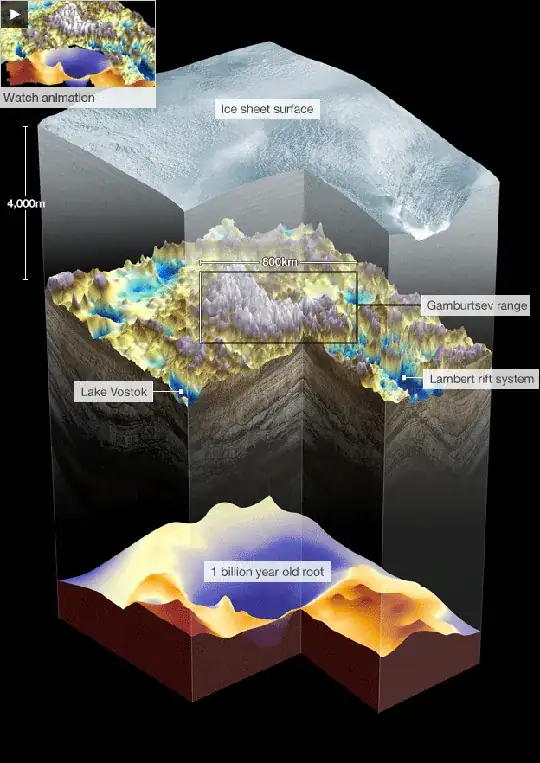
Gamburtsev

The Gamburtsev Mountain Range (also known as the Gamburtsev Subglacial Mountains) is a subglacial mountain range located in Eastern Antarctica, near Dome A.The range was discovered by the 3rd Soviet Antarctic.

It is approximately 1,200 kilometres (750 mi) long, and the mountains are believed to be about 2,700 metres (8,900 ft) high, although they are completely covered by over 600 metres (2,000 ft) of ice and snow. The Gamburtsev Mountain Range is currently believed to be about the same size as the European Alps.

enter image description here

Rudy Gunawan
  • 6,337
  • 4
  • 31
  • 52
18

Try Egypt, or the Sahara at large. in 2012 a WWII british airplane was found 70 years after it made an emergency landing in Egypt. The poor pilot made it safely on to the ground, the sad part is that it took 70 years before some one else came along. It was still in pristine condition. In that time simply nobody passed that location. Who knows what still lies out there.

JonathanReez
  • 82,178
  • 90
  • 394
  • 764
17

Many Parts of New Guinea have not been reached yet because of extensive forestation:

The uncontacted tribes in the Brazilian Amazon are fascinating! Here is a link to a video clip of a flyover, where you can peek into the lives people who have never been contacted before!

Mark Mayo
  • 160,001
  • 106
  • 687
  • 1,492
shnozolla
  • 574
  • 3
  • 3
13

In addition to what Kate said about rivers, it's worth noting that current mapping of even oceans is subject to change, error or re-writing.

Late last year a team of scientists was in the South Pacific doing a geographical survey of Sandy Island, 20 miles long and 5 miles wide.

There was just one problem. The island doesn't exist. It was on Google maps and other sources showed it but when they turned up - the water depth was 1400m!

A relevant quote from a Google spokesperson sums it up nicely:

"One of the exciting things about maps and geography is that the world is a constantly changing place and keeping on top of these changes is a never-ending endeavour".

hippietrail
  • 80,147
  • 56
  • 281
  • 643
Mark Mayo
  • 160,001
  • 106
  • 687
  • 1,492
13

Apparently some of the Venezuelan Tepui remain unexplored. Many of them are part of a national park however, and you might need permits to vist (and you couldn't leave a flag there!)

Colin Pickard
  • 483
  • 3
  • 10
12

I would be very surprised if the majority of either Antarctica or Greenland has ever been touched by a human on the ground. On the other hand, there's effectively nothing to see in such locations, either.

Loren Pechtel
  • 8,134
  • 28
  • 34
7

Caves!

  • 1,083,206,916,846 km3. volume
  • 510,072,000 km² surface area

There is a huge difference in area to explore under the surface. As well, Google Earth can't see underground. Granted, it could be hard and not interesting to dig a hole. The idea of "Journey to the Center of the Earth" comes to mind. You could spend generations digging, or you may enter and never come out.

Kate Gregory
  • 82,075
  • 14
  • 237
  • 340
Naithiz
  • 71
  • 1
  • 1
5

Sơn Đoòng Cave was only discovered in 1991 and has the largest known cavern in the world.

It has only been open to tourists since 2013 and only small numbers at that.

When you consider that this cave was unknown until so recently, it's safe to say there are many more caves in inhospitable parts of the world that have yet to be discovered (or maybe rediscovered). Maybe even some that are bigger than Sơn Đoòng.

Jungles, mountain ranges and remote islands are all good candidates for exploring. Remote islands with mountainous jungles combine all these things and make for excellent candidates (ie Papua)

And of course the ocean floor is the largest of all unexplored territories.

daamsie
  • 2,052
  • 14
  • 16
4

Maybe Gobi Desert is one of them where human try to go but do not return.

Dirty-flow
  • 14,772
  • 18
  • 70
  • 127
Ali Asad
  • 1,065
  • 8
  • 17
4

Desert. Not only the Sahara or Gobi as mentioned but in general all deserts. I remember this radio talk and that guy, P.Frey, claims he is the only person to have crossed the Sahara in the East-West direction. Mostly because people living in the desert actually live in small areas and never really cross it.

In general deserts are by definition not places with settlements and nobody visits them on a regular basis. There is little knowledge about them.

drat
  • 12,630
  • 8
  • 60
  • 89
Vince
  • 21,035
  • 11
  • 90
  • 146
4

A lot of forest areas in India, south Asia or Africa might be be unexplored. GE can give an aerial view but it is very difficult to determine what is actually going underneath the forestation. These areas might be inhabited too.

1

There are a surprisingly large number of unclimbed mountains left. Most of the tallest ones are off limits for political and/or religious reasons, but an even more surprising number of peaks have never been climbed simply because they're overshadowed by other, more famous summits (many in the Himalayas) or are just in really awkward locations (Kazakh/China border, Antarctica, etc).

I also have to pitch the Degree Confluence Project, which aims to visit every point where degrees of latitude and longitude intersect. As of today, they're only 40% complete.

lambshaanxy
  • 99,971
  • 45
  • 616
  • 891
0

In many wild places (as "explorer").

Also in Europe (and central Europe) we may find new caves, or new geographical features nobody cared to share, and probably nobody passed nearby. Maybe some shepherds passed nearby, but sometime I doubt it. Note: maybe there is a path within few kilometers, so not real adventurous explorations.

Also mountains: we got on most important peaks, but not on all sides and for sure not on many small secondary peaks. Without climbing equipment some places are inaccessible.

On coastal regions, you get the same (but maybe a small boat can stop nearby, but rocks may makes very dangerous also to swim nearby), and very difficult without equipment to go down (unstable terrain, and usual rocks). The same on many rocks on sea (some also large and remote).

Note: exploration is not just going to a place, but it is also reporting back, but probably there are not many places which may excite the public.

Giacomo Catenazzi
  • 10,120
  • 27
  • 43