15

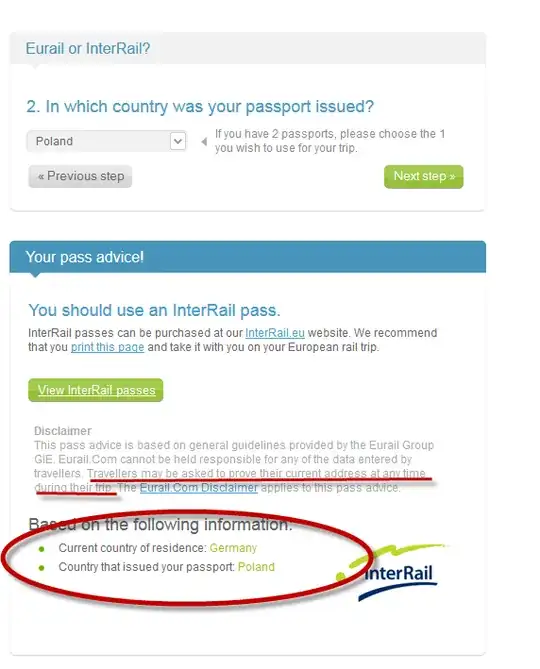
The InterRail site states that InterRail pass is not valid in my country of residence. How do they determine my country of residency?

I'm working in Germany, so from Germany's view I'm a German resident. But I have a permanent registration (meldunek) in Poland and that's the address that is on my personal ID. So if I'd have to proof my permanent residence in the other country, it would by Poland.

So in which countries can I use InterRail? Can they forbid me using it in both Germany, claiming I work there, and Poland, where I'm registered? Or I can 'choose' my country of residence, because I could proof my residency in both countries?

Just to make it clear: I could prove my residency in Germany by having with me the German registration, the work contract, the health insurance etc. and make my life complicated to be granted a right to pay extra for the trains in Germany, but it's not my point. I ask, what documents I am required to prove my country of residence? What is the minimal subset?

Is the country of residence where I have permanent registration? If so, it's Poland, because it's on my personal ID.

Is it the country of shipment of InterRail? Seems to be very simple rule to check. Then it's Germany where I live.

The problem is, the FAQ gives no clue how the 'country of residence' is applied for expatriates, in context of InterRail internal regulations (not the EU civil law etc.).

blackbird
  • 16,901
  • 7
  • 54
  • 125
Cjxcz Odjcayrwl
  • 7,480
  • 8
  • 43
  • 83

4 Answers4

14

It's been a long time since I used an InterRail pass, but in practice, the basic assumption is that your country of citizenship is your country of residence.

If you think about it, there's no other feasible option: if Lukasz shows up in Germany and buys an IR pass with his Polish passport, there's no possible way for the DB ticket office, or any DB ticket conductor, to know that, in addition to his Polish passport, he happens to be resident in Germany. (No, DB is not hooked up to the immigration computers!)

As a personal data point, I once used my Finnish passport to get an IR pass that included Hungary in Budapest. No questions were asked, and they didn't even ask if I was a resident of Hungary (which I wasn't, but I could well have been!).

Now as Dirty-flow's answer states, buying a pass for a country where you live is against the terms and conditions, although calling it "fraud" is (IMHO) a bit much. I presume the rule exists to stop people from using IR passes for long-distance commuting or something in the country where they live, so as long as you're not obviously abusing the system, I wouldn't worry too much. YMMV.

lambshaanxy
  • 99,971
  • 45
  • 616
  • 891
11

As you live and work in Germany (I assume you're in Germany for more than 180 days/year) you cannot use the InterRail pass in Germany. Claiming to reside in Poland while you actually live in Germany would be a fraud.

Take your proof of residence (Meldebescheinigung) with you on the trip to prove your current adress (if asked by a conductor). It should be more than enough to prove that you're German resident.

From interrail.eu:

Travellers may be asked to prove their current adress at any time during the trip.

screenshot

Flimzy
  • 20,437
  • 15
  • 89
  • 162
Dirty-flow
  • 14,772
  • 18
  • 70
  • 127
1

The current country of residence counts. It is the one where you are registered as a resident, work, pay your taxes, even if your citizenship is different.

You probably have some kind of residency permit / ID that may prove it.

Passports emitted by a foreign consulate can also have the address mentioned with the other country specified. But it can be outdated as those documents are valid for 10 years.

I am an expatriate too, and occasionally use Interrail passes to travel back to my country of citizenship. Very convenient to see relatives who live far away from each other, in a large country!

DavGin
  • 11,409
  • 8
  • 55
  • 86
-6

As Interrail is ment for travellers going sightseeing or on vacation, the country of recidency is probably the one from where you start your trip (and where your trip ends) among the countries of which you are resident. This should be the couyntry where you buy the ticket. For this country you should keep a proof of residency with you.

If the rules didn't change in the last few years, you have to write down every train that you take for interrail. Further more you can prove every flight with your tickets. So your trip should start at a border station or at a city with airport/ sea port. In the latter case you should have a ticket that proves how you arrived there.

Usually, no ticket inspector will look at your itinary, but they are allowed to do so.

TheEspinosa
  • 326
  • 1
  • 6