33

I am looking at flights from Boston to Paris and I see that there are two non-stop flights with different travel duration:

enter image description here

For this itinerary, Air France takes 6h40 while Delta takes 7h04.

Why don't they have the same travel duration? Is it typically due to the type of airplane, the route, or something else?


Another example (2h10 difference):

enter image description here

Franck Dernoncourt
  • 60,186
  • 35
  • 215
  • 416

6 Answers6

39

Assuming they are not code sharing the identical flight :-).
While I have flown frequently in recent years, the following are "common sense" conjectures, not information based on knowledge of the deep inner workings of the system - as will be obvious when you read them.

  • Delta may be more honest or realistic than Air France.
    Pilots quite frequently announce "we are eg 15 minutes earlier / later than expected due to ...". Usually head or tail winds. The mean or the median or the 3rd quartile or ... trip times may all be valid figures to use.

  • The two airlines may use a different terminal at one or both ends with different taxi and processing times.

  • An airline may choose to fly a less aggressive more fuel efficient flight profile.

  • As boarding time is affected by actual departure time the airline MAY choose to alter projected departure times to manage passenger expectations.

  • I had meant to add (honest :-) ), but forgot, and it was pointed out by others subsequently - aircraft capabilities may differ. Apparently, fastest by a nose, you'll get is ~+ 0.86 mach in a 747-400. That's probably air speed so ground speed will vary with altitude and wind speed. There are various cost/speed tradeoffs and some aircraft will reward their operators more with lower speeds. See list of claimed cruising speeds as a fraction of mach 1 at end of this post.

  • They may have different security arrangements. For example, on some flights that I have taken, at some airports QANTAS have their own portable XRay machine and re XRay passengers luggage at the gate. You'd not expect this to affect shown transit time but it could depending how they determine these figures.


Optimum cruising speeds:

These speeds are user supplied from a discussion here. This provides a short but useful comment on variation of mach 1 with altitude.

Boeing 747-400 0.86
Boeing 787 0.85
Boeing 777 0.84
Boeing 767 0.80
Boeing 757 0.80
Boeing 737 -800 0.78
Boeing 737 - 300/400/500 0.74

Airbus 380 0.85
Airbus 340 -300/600 0.82
Airbus 330 0.82
Airbus 320 0.78
Airbus 310 0.78

McDonnell MD-11 0.85

Russell McMahon
  • 10,282
  • 35
  • 49
19

The differing durations are a result of the aircraft that are used to fly the route by the two airlines. Delta uses a Boeing 757 aircraft while the Air Frances uses the slightly faster Boeing 747 and Boeing 777 aircraft on this route.

rubai
  • 191
  • 2
7

Depending on plane ETOPS, route can be different, even if the planes have the same engine number. 777 has quite a big ETOPS...

edit: To add some explanation. ETOPS (Extended range Twin Operations) is a rule which allows 2 engine planes to fly over oceans. Depending on how strongly the manufacturers promise that their engines are reliable the plane may be certified to fly routes where they are upto 120, 180, 330 minutes from the nearest airport.

A flight from the USA to Europe wouldn't normally be very much longer even for 120min ETOPS.

Vince
  • 21,035
  • 11
  • 90
  • 146
gougoul
  • 79
  • 1
6

While this is just as much of an educated guess as all of the other answers, I would suspect that part of it is probably due to congestion at one or both terminals at the scheduled times of day. You can see this effect even on domestic flights. Even for the same cities on the same airline with the exact same model of aircraft, it's not unusual for scheduled durations even on domestic routes to vary by 5-15 minutes depending on time of day, especially at major hubs (which both Boston and CDG are.)

I do suspect that aircraft type also has something to do with it in this particular case, though. As other answers have mentioned, the 757 cruises a bit slower than the 777 or 747 (at 35,000 ft: Mach 0.80 for 757 vs. Mach 0.84 for 777 or 747-400.)

Edit: My answer originally stated that the 757 was limited to 120 minute ETOPS (e.g. that it was required to stay within 120 minutes of a potential diversionary field.) However, according to Boeing, 757-200s (both RR and P&W engine configurations) were upgraded to 180 Minute ETOPS certification. I have updated the map below from gcmap to show areas where the 757 is allowed to fly under 180-minute ETOPS, which includes the entire North Atlantic. As such, the 757-200 is not limited on where it can fly between BOS and CDG by ETOPS regulations, so ETOPS shouldn't be a factor in why the Delta flight takes longer.
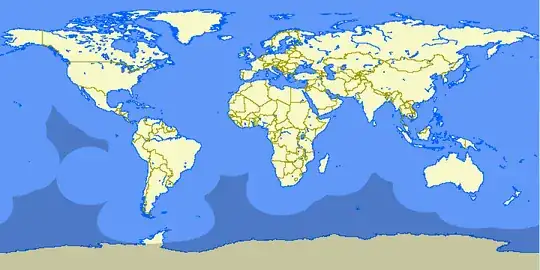

757 180 Minute ETOPS map

reirab
  • 13,709
  • 2
  • 56
  • 94
5

Different airlines will estimate different times based on their own data. As such, it is reasonable to expect a few minutes variation from one airline to the next.

Large variations between flights at significantly different times of the day can also occur (even for the same airline). This is often due to the congestion of planes at peak times of day. I recall an article (that I can't find at the moment) that noted one airline had more than an hour of extra time for a particular route that arrived at a very busy airport. The same route earlier in the day didn't need the extra buffer.

For the example you illustrated, the flights nearly overlap. However, the Delta flight leaves at 7:00 (a peak traffic time). It could easily be that the Delta flight is anticipating sitting in "heavy traffic" waiting to take off. Since departure times are based on the time leaving the gate and entering the queue to take off, this causes a longer flight.

Likewise, 7:00 AM might be a higher traffic time than 8:00 AM for the arrival airport.

Andrew Ferrier
  • 12,421
  • 10
  • 67
  • 98
Elros
  • 231
  • 1
  • 6
2

I have observed within Europe, that some airlines tend to overestimate the duration that their flights take, for flights of 2:30 duration of around 10-12 minutes. This way, even if there's unexpected delay, the plane will still arrive on time.

A pilot once told me that this has behavioral reasons. People don't mind being a bit late, but being a bit later than expected, that's the worst!

Whether Delta does that, and to what extend they do this with long-distance flights, I am unaware of.

FooBar
  • 491
  • 1
  • 4
  • 14