Well, I would like to present some different, than Mark's & Piotr's, point of view. You have plenty of time, so you can get from Auschwitz to Wieliczka by bicycle and visit both KZ and salt mine in a single day :)
tl;dr
Yes, it is possible to do the single trip with Auschwitz and Wieliczka in one day!
Hiring a car, taking an organized trip, or just get Uber/Bolt/Freenow/cheap taxi (see below sections) would be my recommendation. Public transportation would be cheaper but yet more challenging option. It requires more free time and take-ins, but it is not impossible.
You may also get a bicycle trip. Having 5.5 - 8 hrs. spare time (depending on the month) and 80 km distance, you can get to Wieliczka by bicycle.
NOTE that Auschwitz in Polish language is Oświęcim. In Poland, Auschwitz name is considered more as the concentration camp and Oświęcim as both camp and the city.
Auschwitz-Birkenau concentration camp
The Auschwitz concentration camp opening hours varies month by month and are:
- 8:00 AM - 2:00 PM December
- 8:00 AM - 3:00 PM January, November
- 8:00 AM - 4:00 PM February
- 8:00 AM - 5:00 PM March, October
- 8:00 AM - 6:00 PM April, May, September
- 8:00 AM - 7:00 PM June, July, August
Also note:
These are the hours of entrance to the Museum. A visitor may stay on the site of the Museum 90 minutes after the last entrance hour (i.e. 5.30 in February or 8.30 in July)
Time needed for Auschwitz-Birkenau concentration camp is 3.5 hrs:
As a minimum, however, at least three-and-a-half hours should be reserved.
Wieliczka Salt Mine
Please note that Wieliczka has a single salt mine. Another salt mine open to sightseers in the region is Bochnia Salt Mine which is located slightly more than 40 km (~25 mi) from Kraków.
Wieliczka Salt Mine opening hours for the "Tourist Route" are:
The route is open from 09:00 am to 05:00 pm, and the tour in
English-speaking takes place at the following times: 10:00 am, 11:00
am, 12:00 pm, 01:00 pm, 02:00 pm, 03:00 pm, 04:00 pm, 05:00 pm
The closing hour means "hour of closing ticket desks and last group of tourists entering the mine."
Please note that alternative routes (Miners' Route, Pilgrims' Route, Group Adventure, The Mysteries of the Wieliczka Mine) have different schedules.
Planning
I'd suggest to start with Auschwitz-Birkenau concentration camp.
Starting from 8:00 AM + 3.5 hrs = 11:30 AM.
Assuming the last entry to Wieliczka Salt Mine is either 7:30 PM or 5:00 PM, that gives you consecutively 8 or 5.5 hours of time (depending on the month) for getting from Auschwitz to Wieliczka.
The distance from Auschwitz to Wieliczka is approx. 80 km (~50 mi). The route can be taken via "A4" highway and it takes, in the optimistic scenario, 1 hour. You may use Google Maps which calculates pretty accurate traffic in Poland. I wouldn't expect much traffic in the noon/afternoon time.
Get In
Car
Hire one and you will have a plenty of free time. Remember to use Google Maps to avoid tolls and traffic.
/ Bus, Minibus & Train
Whether you go by bus, minibus or train, if you want to check timetable online, you should probably look for:
- From: Kraków \ Kraków Główny \ Kraków Dworzec Główny
- To: Oświęcim
That may be obvious, but some may want to look for Auschwitz rather than Oświęcim.
Direct and indirect connections
Go to the e-podroznik (English language available) and check the route for your destination. There are many options available and the website lists the travel time, walking time, transport type, prize and option to buy a ticket online (for some routes).
From-To Auschwitz
Schedules:
As per Auschwitz Memorial & Museum official website:
The Museum is located on the outskirts of the city of Oświęcim on
national road 933 (note: entry to the parking lot is at Stanisławy
Leszczyńskiej Str. no. 16). The Museum is about 2 km. from the train
station and can be reached from there by local buses.
Transportation between camps is as following:
Communication between former Auschwitz I and Birkenau concentration
camps
Auschwitz I and Auschwitz II-Birkenau are situated 3,5 km from each
other.
Car parks
There are paid car parks available near both former concentration
camps.
Museum Bus
Every hour the museum bus shuttles from one concentration camp to
another. Departures from the former Auschwitz concentration camp:
between April - October every 15 minutes, between November - March
every 30 minutes. No bus fare is required.
TAXI
Taxi services are provided by HALO TAXI company. You can find a taxi
at the taxi rank in front of the Museum entrance. You can also call a
taxi using the following phone number: +48 32 19 194.
By foot
The three kilometre distance between the former concentration camps
can be covered by foot (through streets: Leszczyńska and Wyzwolenia),
crossing the by-camp premises, where during the occupation were German
industrial plants and workshops, warehouses, offices and technical
backrooms, in which the prisoners would work and die. There are
preserved remains of a few railway sidings and ramps [link to
Judenrampe], where the trains with deportees would stop and the
members of the SS would make the selections.
From-To Wieliczka
Schedules:
As per official website:
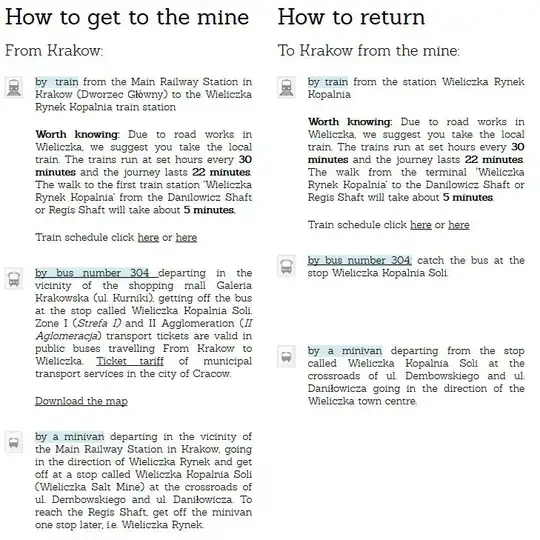
Almost all underground routes begin at the Danilowicz Shaft located in
the area of the Mine. Only The Miners’ Route and the Mysteries of
Wieliczka Mine start from the Regis Shaft located in the centre of the
town.
☂ Organized Tour
There are many organized tours in Kraków, so you may easily reach one and ask for a single day tour.
Example: Cracow City Tours organizes a full day trip to Auschwitz and Wieliczka.
Taxi, Uber, etc.
You may also try Uber, Bolt or FreeNow.
I've just checked Uber and Bolt options -- it costs around 275 PLN to get from Oświęcim to Wieliczka.
If not, you may try to call either iCar or Mega Taxi, which are the cheapest and the most reliable taxi options. Both taxis have mobile apps, so you may use these as well.
♀️ Bicycle
It's around 80 km to get from Auschwitz to Wieliczka, so... why not biking. Having 5.5 - 8 hrs. spare time (depending on the month) and 80 km distance, you can get to Wieliczka by bicycle.
You may use Google Maps for the bicycle trip, but Google Maps may do not find suitable path for your bicycle type. I'd recommend to use either Mapy.cz app (free option and you can choose between Mountain Bike and Road Bike) or Naviki (free with minimum options, but you can choose between plethora of bicycles: Everyday/Leisure/Mountain/Racing/S-Pedelec).
With avg. of 25 km/h, you will get to Wieliczka in less than 3.5 hours.
Costs
Also, I'm wondering if it will be cheaper and more cost-effective to join to an organized group or do it on my own?
Organized trip would cost you about twice as non-organised trip with public transportation. The cost of a single-day organized trip with tickets included is 260 PLN (~60 EUR). An entrance to Auschwitz-Birkenau concentration camp is free. An individual ticket for Wieliczka Salt Mine costs from 80 PLN (~20 EUR). Public transportation requires more take-ins and may be much more difficult, but still – it is doable.
Trivia — AUSCHWITZWIELICZKA
There's even a sculpture called AUSCHWITZWIELICZKA:
Mirosław Bałka's sculpture AUSCHWITZWIELICZKA was created in 2008–2009. The work takes the form of a concrete tunnel 17 metres long, 2.5 metres high, 2.5 metres wide and weighing 17 tonnes. The inscription ‘AUSCHWITZWIELICZKA’ has been cut into the ceiling of the tunnel and is projected onto its walls. As of 2018, the sculpture has been part of the MOCAK Collection.
Mirosław Bałka's work is an ironic reference to Krakow tourist offices offer of combined tours to the Wieliczka Salt Mine and the Auschwitz-Birkenau camp. This combination advertises the service, but is completely devoid of any reflection on the meaning of these places and the memory that belongs to them. Mirosław Bałka chose the form of a tunnel because it is a symbol of passage. However, there is no passage between the two places, because they are different worlds. One does not merge with the other. The irony is highlighted by merging the names of these places into one word. The material used in this sculpture – raw concrete, often appears in this artist’s works.
Read more at Mocak.


