40

Well, this has happened to everyone at some point - you find out there is no toilet paper just after you need it the most. Usually it's not a big deal, even in public toilet room you can wait until you hear someone nearby and kindly ask for paper.

However when such thing happens in a foreign country it might get more complicated, e.g. you don't speak the native language well enough to know what to ask for or you fear the response of people from different culture.

Personally this happened to me only once in a "friendly" place (USA) with culture very similar to what I have at home (Israel) so I knew what you ask for and got help rather fast, but ever since I wonder sometimes what I would do in totally "foreign" place.

So, suppose such thing happens - what is considered best practice? Are there any cultures that might consider such request from innocent tourist as rude or even offensive?

JoErNanO
  • 52,873
  • 18
  • 166
  • 277

3 Answers3

24

In most cultures where toilet paper is NOT used, people still need to clean up, right? Well the answer to that is they usually clean up with water. How this is done depends on how 'upmarket' your toilet is. The fancier toilets, even among squat toilets, have shower hose type attachments to a tap: use a stream from this hose down your nether regions.

The situation really gets hairy when you simply have a mug or jar left in the toilet. This is the most typical setup for many remote locations when travelling and probably the scariest. In this situation, the custom is to fill up the mug / jar - and there's no easy way to put this - pour a stream on your (left) hand and wipe off. Usually there should be soap left in the toilet for washing your hand after you've done this - 'remnants' (literally) will stick to your hand in many cases. If there isn't any soap then my best piece of advice is to always carry dry antibacterial handwash which you can buy in small bottles and even a tiny amount of handwash can clean / disinfect your hand efficiently.

Mark Mayo
  • 160,001
  • 106
  • 687
  • 1,492
Ankur Banerjee
  • 38,563
  • 19
  • 141
  • 253
15

Well firstly, some find the whole 'toilet' discussion mildly gross, rude or offensive - even if some don't think so. Especially in certain cultures, trying to show what you want or need to do may draw laughter or anger. Be careful in Muslim cultures, where indicating or offering your left hand (the 'unclean' hand) can cause offense.

It's not a universal thing, either. Consider this quote:

Whilst traveling in the middle Atlas in Morocco we, (a small group of travelers), needed to “use nature’s bathroom’. We went outside, did our business opposite a breathtaking view and collected our toilet paper and burnt it and returned to the main tent. Our hosts did not understand English but the one word they managed to remember that we understood whilst they repeated our actions to the rest of their family was ‘toilet paper’. They found it incredibly funny that we actually use toilet paper.

Then there are different types of toilets, from western style ones, to Japanese toilets, to squatting toilets, to long drops, each with their own (excuse pun) pitfalls.

enter image description here

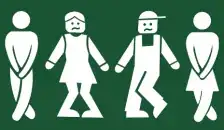
However, if you approach people with a worried looking face, an apologetic expression, mention toilet and bunch one hand up and 'wipe' it with the other hand, it's amazing how simply signing and emotion can translate to someone in any language. Assuming they wipe, that is. The apologetic expression almost always avoids offense as well, as it's hard to take offense if the other person makes it plain and obvious that they're desperate not to cause it in the first place.

Worst case - outdoors, bushes, leaves. It's rough, but we managed for centuries this way, you can manage in a pinch ;)

Mark Mayo
  • 160,001
  • 106
  • 687
  • 1,492
7

Less than a couple of centuries ago, people used whatever materials were to hand to wipe or scrape themselves clean (for instance, see http://en.wikipedia.org/wiki/Toilet_paper#History ). In 18th- and 19th-century London, oyster and mussel shells were commonly used. In some countries where toilet paper is in short supply, torn-up sheets of newspaper are often substituted.

If toilet paper and/or water-based cleaning is (or is likely to be) unavailable, some kind of scraping implement, like a large teaspoon or rigid spatula (such as the type used for applying hair-removal wax), is probably the most practical expedient. Depending on the location/situation, it may be possible to wipe the implement on adjacent vegetation or to knock it against a rock or some other hard object in order to dislodge accumulated excrement. Of course, this does presuppose that one has a suitable scraper on one's person when the need arises...

Erik Kowal
  • 481
  • 4
  • 5