Update - November 2017
On the 13th of November, the preliminary injunction (which prohibited the US government to enforce the presidential proclamation) was stayed except for foreign nationals who have a credible bonafide relationship with someone in the US.
A summary of the subject countries is:
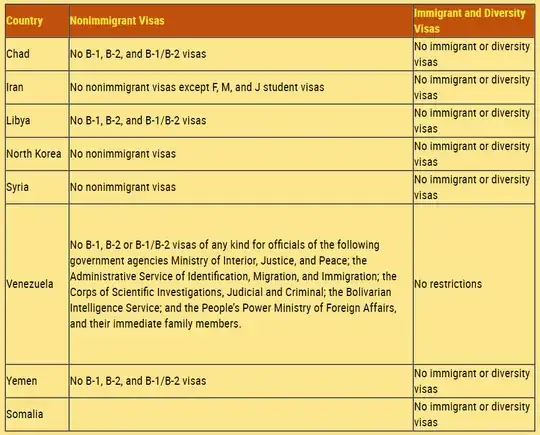
So nationals of Chad, Iran, Libya, Somalia, Syria, and Yemen will remain travel restricted to the US unless they have a parent, including parent-in-law, spouse, fiancé, child, adult son or daughter, son-in-law, daughter-in-law, sibling, brother-in-law, sister-in-law, grandparent, grandchild, aunt, uncle, niece, nephew, and first-cousin. For all relationships, half or step status is included (e.g., “half-brother” or “step-sister”) in the US. Any other extended family members will not count as a bonafide relation.
Situation as of Saturday 4 February, 2017
A federal judge has rules the ban is unlawful/unconstitutional and until further notice, the ban is on hold. This means any national of the aforementioned countries, with a visa or green card, can currently travel to the USA. This might change any moment if a higher court rules differently, so if you live in the USA (like with a student or J-1 visa), you should travel ASAP.
Situation as of Saturday 28 January, 2017
The ban includes both immigrant visas, nonimmigrant visas, and green card holders. From the executive order (emphasis mine):
I hereby proclaim that the immigrant
and nonimmigrant entry into the United States of aliens from countries referred to in section
217(a)(12) of the INA, 8 U.S.C. 1187(a)(12), would be detrimental to the interests of the United
States, and I hereby suspend entry into the United States, as immigrants and nonimmigrants, of
such persons for 90 days from the date of this order (excluding those foreign nationals
traveling on diplomatic visas, North Atlantic Treaty Organization visas, C-2 visas for travel to the
United Nations, and G-1, G-2, G-3, and G-4 visas).
According to Reuters, a Department of Homeland Security (DHS) spokesperson said greencard holders are included as well:
People holding so-called green cards, making them legal permanent U.S. residents, are included in President Donald Trump's executive action temporarily barring people from seven Muslim-majority countries from entering the United States, a Department of Homeland security spokeswoman said on Saturday.
There is ongoing confusion concerning people with dual nationality, such as people holding both UK and Iranian passports. (However, dual nationals who also hold US citizenship are OK, since US citizens cannot be denied entry to the US.)
The only currently stated exceptions are holders for the aforementioned visa categories, which essentially means diplomats, UN personnel, or NATO staff:
Late Saturday
A federal court, responding to a lawsuit filed on behalf of detained travelers, has issued an emergency stay quashing part of the order for the time being. It forbids the US Government from
removing individuals with refugee applications approved by U.S. Citizenship and Immigration Services as part of the U.S. Refugee Admissions Program, holders of valid immigrant and non-immigrant visas, and other individuals from Iraq, Syria, Iran, Sudan, Libya, Somalia, and Yemen legally authorized to enter the United States.
This does not say that the persons concerned have to be let into the United States, only that they can't be sent back. It is possible they will stay in limbo at the airports until the legal situation clears up further.
It is also not clear if airlines will now allow such persons with already issued visas to board flights to the US.
Update: Sunday January 29, 2017
Airlines have started to refuse boarding to those holding valid visas from those countries that are on the temporary ban list; and some passengers have been stopped at transit points.
Five Iraqis and a Yemeni national were kept from boarding a flight
from Cairo to New York on Saturday, despite all seven people having
already obtained the necessary migration visas to enter the United
States.
Source: DW
In The Netherlands, the Dutch flag carrier KLM said it had stopped
seven passengers from boarding its flights, five of whom it had been
able to contact before departure. The identities of the seven, their
countries of origin and destinations were not given.
"We would have liked to have had them fly with us, but it would not
have made much sense because they would have been denied entry" to the
United States, KLM spokesman Manel Vrijenhoek told AFP news agency.
In Canada, WestJet Airlines said it turned back a passenger bound for
the United States on Saturday in order to comply with an executive
order that prohibits people from seven Muslim-majority countries from
entering the United States.
WestJet spokeswoman Lauren Stewart said the airline would give full
refunds to anyone affected by the US executive order. It did not say
which country the passenger had come from.
Source Al Jazeera
Sunday January 29, 2017
British Conservative Member for Parliament Nadhim Zahawi is now unable to visit his sons who are at Princeton University. He represents Stratford on Avon, The birthplace of William Shakespeare. Zahawi is a British Citizen who was born in Iraq under the rule of Saddam Hussein, from which his Kurdish family fled in 1976 when Zahawi was aged 9.
Source: BBC
The US State Department said that Britons with dual nationality with Syria, Iraq, Iran, Sudan, Libya, Somalia and Yemen will be stopped at the US border for the next 90 days.
Source: The Telegraph
British Foreign Secretary Boris Johnson held conversations with the US government on Sunday.
The Foreign Office then advised British travelers that dual citizens were only affected if traveling to the US from one of the seven banned countries.
Source: BBC
Omid Nouripour, a Green Party MP with German-Iranian citizenship, is reported to be one of ten thousands of German citizens believed to be banned from entering the US under new rules. Nouripour is the vice chair of the German parliament’s American-German group and a member of the steering committee of Germany’s Atlantic Bridge programme.
Source: SPIEGEL,WELT
Canadian dual citizens might be exempt as long as they travel on their Canadian passport, though whether US immigration will make that distinction in the current uncertainty remains to be seen.
Source: Government of Canada, Canadian Prime Minister's tweet
U.S. Customs and Border Protection (CBP) has briefed the global trade group that passport-holders from states such as Iran and Iraq, including cabin crew, will be barred entry to the United States, IATA said in an email to its member airlines, seen by Reuters.
Source: Reuters


