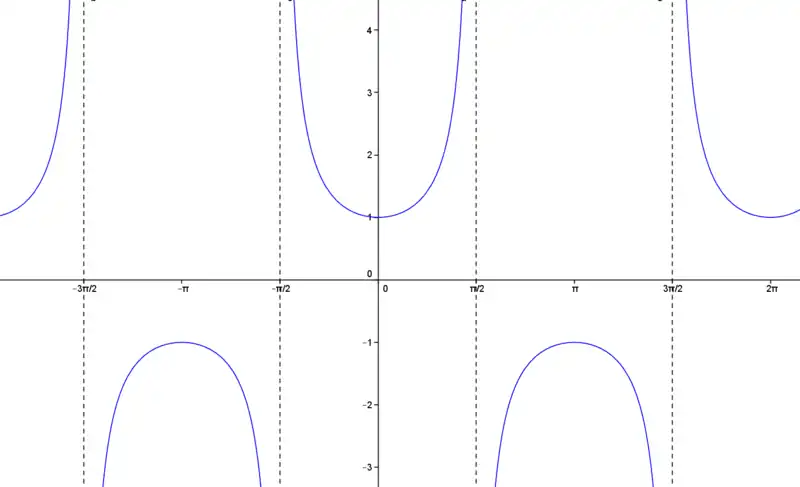
Shape of Secant Function
Theorem
The nature of the secant function on the set of real numbers $\R$ is as follows:
- $(1): \quad \sec x$ is continuous and strictly increasing on the intervals $\hointr 0 {\dfrac \pi 2}$ and $\hointl {\dfrac \pi 2} \pi$
- $(2): \quad \sec x$ is continuous and strictly decreasing on the intervals $\hointr {-\pi} {-\dfrac \pi 2}$ and $\hointl {-\dfrac \pi 2} 0$
- $(3): \quad \sec x \to + \infty$ as $x \to -\dfrac \pi 2^+$
- $(4): \quad \sec x \to + \infty$ as $x \to \dfrac \pi 2^-$
- $(5): \quad \sec x \to - \infty$ as $x \to \dfrac \pi 2^+$
- $(6): \quad \sec x \to - \infty$ as $x \to \dfrac {3 \pi} 2^-$
Proof
From Derivative of Secant Function:
- $\map {D_x} {\sec x} = \dfrac {\sin x} {\cos^2 x}$
From Sine and Cosine are Periodic on Reals: Corollary:
- $\forall x \in \openint {-\pi} \pi \setminus \set {-\dfrac \pi 2, \dfrac \pi 2}: \cos x \ne 0$
Thus, from Square of Non-Zero Element of Ordered Integral Domain is Strictly Positive:
- $\forall x \in \openint {-\pi} \pi \setminus \set {-\dfrac \pi 2, \dfrac \pi 2}: \cos^2 x > 0$
 | Although this article appears correct, it's inelegant. There has to be a better way of doing it. In particular: Might need to find a less abstract-algebraic version of the above result You can help $\mathsf{Pr} \infty \mathsf{fWiki}$ by redesigning it. To discuss this page in more detail, feel free to use the talk page. When this work has been completed, you may remove this instance of {{Improve}} from the code.If you would welcome a second opinion as to whether your work is correct, add a call to {{Proofread}} the page. |
From Sine and Cosine are Periodic on Reals: Corollary:
- $\sin x > 0$ on the open interval $\openint 0 \pi$
It follows that:
- $\forall x \in \openint 0 \pi \setminus \set {\dfrac \pi 2}: \dfrac {\sin x} {\cos^2 x} > 0$
From Sine and Cosine are Periodic on Reals: Corollary::
- $\sin x < 0$ on the open interval $\openint {-\pi} 0$
It follows that:
- $\forall x \in \openint {-\pi} 0 \setminus \set {-\dfrac \pi 2}: \dfrac {\sin x} {\cos^2 x} < 0$
Thus, $(1)$ and $(2)$ follow from Derivative of Monotone Function and Differentiable Function is Continuous.
From Zeroes of Sine and Cosine::
- $\cos - \dfrac \pi 2 = \cos \dfrac \pi 2 = \cos \dfrac {3 \pi} 2 = 0$
From Sine and Cosine are Periodic on Reals: Corollary:
- $\cos x > 0$ on the open interval $\openint {-\dfrac \pi 2} {\dfrac \pi 2}$
From the same source:
- $\cos x < 0$ on the open interval $\openint {\dfrac \pi 2} {\dfrac {3 \pi} 2}$
Thus, $(3)$, $(4)$, $(5)$ and $(6)$ follow from Infinite Limit Theorem.
Graph of Secant Function
$\blacksquare$
Also see
- Shape of Sine Function
- Shape of Cosine Function
- Shape of Tangent Function
- Shape of Cotangent Function
- Shape of Cosecant Function
Sources
- 1968: Murray R. Spiegel: Mathematical Handbook of Formulas and Tables ... (previous) ... (next): $\S 5$: Trigonometric Functions: Signs and Variations of Trigonometric Functions