Shape of Tangent Function
 | This page has been identified as a candidate for refactoring of basic complexity. In particular: Separate the parts into transcluded pages Until this has been finished, please leave {{Refactor}} in the code.
New contributors: Refactoring is a task which is expected to be undertaken by experienced editors only. Because of the underlying complexity of the work needed, it is recommended that you do not embark on a refactoring task until you have become familiar with the structural nature of pages of $\mathsf{Pr} \infty \mathsf{fWiki}$.To discuss this page in more detail, feel free to use the talk page. When this work has been completed, you may remove this instance of {{Refactor}} from the code. |
Theorem
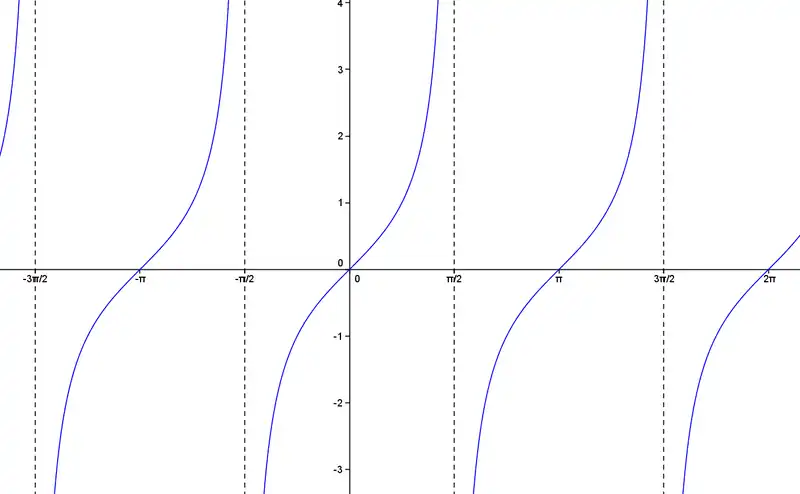
The nature of the tangent function on the set of real numbers $\R$ is as follows:
- $\tan x$ is continuous and strictly increasing on the interval $\openint {-\dfrac \pi 2} {\dfrac \pi 2}$
- $\tan x \to +\infty$ as $x \to \dfrac \pi 2 ^-$
- $\tan x \to -\infty$ as $x \to -\dfrac \pi 2 ^+$
- $\tan x$ is not defined on $\forall n \in \Z: x = \paren {n + \dfrac 1 2} \pi$, at which points it is discontinuous
- $\forall n \in \Z: \map \tan {n \pi} = 0$.
Proof
$\tan x$ is continuous and strictly increasing on $\openint {-\dfrac \pi 2} {\dfrac \pi 2}$:
Continuity follows from the Quotient Rule for Continuous Real Functions:
- $(1): \quad$ Both $\sin x$ and $\cos x$ are continuous on $\openint {-\dfrac \pi 2} {\dfrac \pi 2}$ from Real Sine Function is Continuous and Cosine Function is Continuous
- $(2): \quad$ $\cos x > 0$ on this interval.
The fact of $\tan x$ being strictly increasing on this interval has been demonstrated in the discussion on Tangent Function is Periodic on Reals.
$\tan x \to + \infty$ as $x \to \dfrac \pi 2^-$:
From Sine and Cosine are Periodic on Reals, we have that both $\sin x > 0$ and $\cos x > 0$ on $\openint 0 {\dfrac \pi 2}$.
We have that:
- $(1): \quad \cos x \to 0$ as $x \to \dfrac \pi 2^-$
- $(2): \quad \sin x \to 1$ as $x \to \dfrac \pi 2^-$
From the Infinite Limit Theorem it follows that:
- $\tan x = \dfrac {\sin x} {\cos x} \to + \infty$ as $x \to \dfrac \pi 2 ^-$
$\tan x \to - \infty$ as $x \to -\dfrac \pi 2 ^+$:
From Sine and Cosine are Periodic on Reals, we have that $\sin x < 0$ and $\cos x > 0$ on $\openint {-\dfrac \pi 2} 0$.
We have that:
- $(1): \quad \cos x \to 0$ as $x \to -\dfrac \pi 2 ^+$
- $(2): \quad \sin x \to -1$ as $x \to -\dfrac \pi 2 ^+$
Thus it follows that $\tan x = \dfrac {\sin x} {\cos x} \to -\infty$ as $x \to -\dfrac \pi 2 ^+$.
$\tan x$ is not defined and discontinuous at $x = \paren {n + \dfrac 1 2} \pi$:
From the discussion of Sine and Cosine are Periodic on Reals, it was established that:
- $\forall n \in \Z: x = \paren {n + \dfrac 1 2} \pi \implies \cos x = 0$
As division by zero is not defined, it follows that at these points $\tan x$ is not defined either.
Now, from the above, we have:
- $(1): \quad \tan x \to + \infty$ as $x \to \dfrac \pi 2^-$
- $(2): \quad \tan x \to - \infty$ as $x \to -\dfrac \pi 2^+$
As $\map \tan {x + \pi} = \tan x$ from Tangent Function is Periodic on Reals, it follows that:
- $\tan x \to - \infty$ as $x \to \dfrac \pi 2 ^+$
Hence the left hand limit and right hand limit at $x = \dfrac \pi 2$ are not the same.
From Tangent Function is Periodic on Reals, it follows that the same applies $\forall n \in \Z: x = \paren {n + \dfrac 1 2} \pi$.
The fact of its discontinuity at these points follows from the definition of discontinuity.
$\map \tan {n \pi} = 0$:
Follows directly from Sine and Cosine are Periodic on Reals::
- $\forall n \in \Z: \map \sin {n \pi} = 0$
$\blacksquare$
Graph of Tangent Function
Also see
- Shape of Sine Function
- Shape of Cosine Function
- Shape of Cotangent Function
- Shape of Secant Function
- Shape of Cosecant Function
Sources
- 1968: Murray R. Spiegel: Mathematical Handbook of Formulas and Tables ... (previous) ... (next): $\S 5$: Trigonometric Functions: Signs and Variations of Trigonometric Functions
- 1977: K.G. Binmore: Mathematical Analysis: A Straightforward Approach ... (previous) ... (next): $\S 16.5 \ (2)$
- 1998: David Nelson: The Penguin Dictionary of Mathematics (2nd ed.) ... (previous) ... (next): tangent curve: 1.
- 2008: David Nelson: The Penguin Dictionary of Mathematics (4th ed.) ... (previous) ... (next): tangent curve: 1.